IN BRIEF
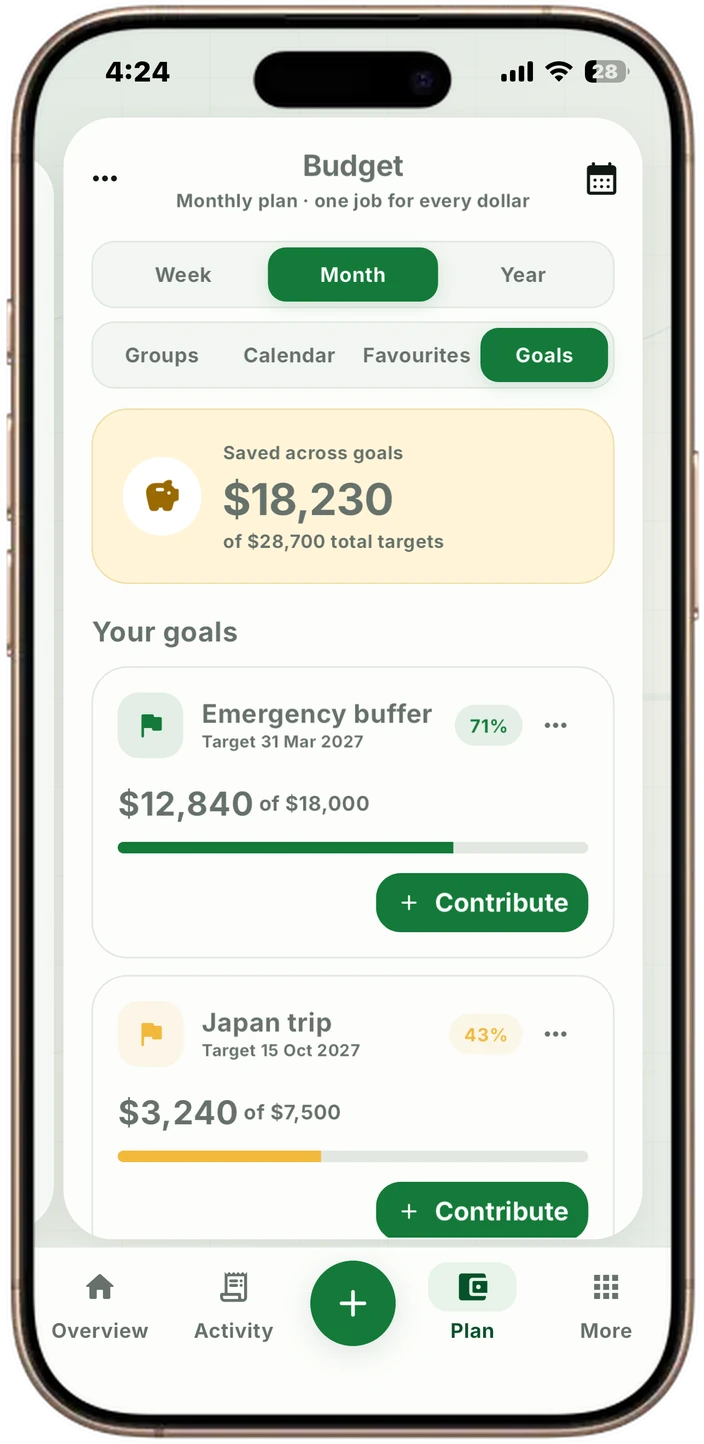
A sinking fund is money you set aside gradually for a cost you can see coming. It turns a bill that arrives occasionally into a regular part of the plan. The important ingredients are the target, what is already saved, and how many contributions remain before payment is due.
What a sinking fund does
Services Australia includes annual and one-off costs such as insurance and car registration when working out spending. Moneysmart also recommends putting aside money for quarterly or annual costs. A sinking fund is a practical way to implement that idea: reserve a little as income arrives, then use the reserve when the bill is payable. [2][3]
The name sounds more complicated than the task. You are not creating a special investment product or a guarantee against price rises. You are assigning existing money to a known future job. A separate account can help, but a clearly maintained category or savings bucket can perform the planning function too.
Choose costs that are genuinely predictable
Start with previous statements and renewal notices. List registration, insurance, school or course costs, membership renewals, gifts and recurring maintenance. For each item, record the likely amount and next due date. If the amount is uncertain, label it as an estimate and set a reminder to confirm it.
| Cost | Planning treatment |
|---|---|
| Annual registration notice | Sinking fund: known recurring obligation. |
| Unexpected urgent repair | Potential emergency-fund use. |
| A holiday you would like to take | Personal savings goal with a flexible deadline. |
| Routine maintenance expected later | Sinking fund using an estimate and review date. |
The categories can overlap at the edges. What matters is that you know why the money is reserved and do not count it towards several purposes at once.
Use the remaining deadline, not a convenient annual average
The core calculation is: expected cost minus money already reserved, divided by the number of contributions remaining before the bill is due. Count contribution dates, not merely calendar months. If your planned transfer happens after the payment date, it cannot help fund that payment.
Make the total contribution affordable
It is easy to create a long list of sensible future funds whose combined contributions do not fit the household income. Add them together before automating transfers. Separate obligations from optional goals and check the consequences of delaying each cost. A realistic reserve for a priority bill is more useful than a small amount spread across too many ambitions.
Moneysmart’s budget method compares all income and expenses before setting savings amounts. If the combined plan is short, review costs and timing rather than treating the reserve transfers as invisible. Providers may offer bill smoothing or payment arrangements; ask about the terms instead of assuming they are available. [1][5]
Keep the reserve separate in your records
If the money stays in your everyday account, subtract reserved amounts before deciding what is available to spend. If it moves to a savings account, record a transfer rather than income. When the bill is paid, record the actual expense and reduce the corresponding reserve. The precise display depends on the tool, but the money should not be counted twice.
Reconcile after each payment and renewal
When the bill arrives, replace the estimate with the actual amount. If it is higher, work out how to cover the gap before payment is due. If it is lower, decide whether the remainder stays for the next cycle or is deliberately reassigned. Do not leave unexplained differences accumulating across several funds.
- Record the payment and check the reserve balance.
- Set the next due date.
- Update the expected cost when a renewal or quote is available.
- Recalculate the contribution using the new time remaining.
- Check that the combined reserve totals still match actual money held.
This closes the loop. Without the reset, a fund can continue collecting the wrong amount or appear funded after its money has already been spent.
Keep the emergency fund for the things you did not plan
Moneysmart describes an emergency fund as a safety net for urgent or unexpected costs. A sinking fund protects it from being used for a predictable bill simply because the bill is large. Both can be useful, but they solve different problems. [4]
If you are starting with limited spare money, prioritise deliberately. You may need to address a near-term essential bill before building several optional funds. There is no requirement to create a separate account for every expense or to fund everything immediately. The first improvement is making the obligations visible.
Frequently asked questions
Is a sinking fund the same as savings?
It is a type of planned saving, but its purpose is a foreseeable cost. Emergency savings cover urgent surprises, while personal goals may be optional. Keeping the purposes distinct makes your available balance clearer.
Should I divide every annual bill by twelve?
Only if twelve monthly contributions remain and no other amount is already saved. A bill due sooner requires a different calculation. Use the remaining gap and contribution dates.
What if the bill increases?
Update the target and calculate the new shortfall. Check the budget, compare appropriate alternatives or ask the provider about arrangements where needed. Do not keep using an old estimate just because it makes the monthly plan balance.
Sources & further reading
Sources checked 30 September 2026. Follow the linked source for current rules and eligibility.
- ASIC Moneysmart — How to do a budget
- Services Australia — Budgeting
- ASIC Moneysmart — Track your spending
- ASIC Moneysmart — Save for an emergency fund
- ASIC Moneysmart — Managing on a casual income
How this guide was prepared
Published by VULT and prepared with AI assistance using the sources linked above. The explanations and fictional examples are original educational writing; they are not personal financial, tax, legal or credit advice. No independent professional review is claimed. Where sources differ, the relevant official authority takes precedence for current rules. Reading time is estimated at 200 words per minute.
Found something that needs correcting? Send VULT feedback, including the guide title and the source you believe needs checking.